
1. Why I'm Writing This
Let me start with what this guide is not:
It's not going to tell you nicotine pouches are "safe" or "harmless." They're not.
It's not going to shame you for using them.
And it's definitely not going to tell you to "just quit cold turkey and use willpower."
Here's the truth: quitting nicotine pouches like Zyn, Velo, and On! is hard, but not because you're weak. It's hard because nicotine rewires your brain's dopamine system. That's not a character flaw—it's neuroscience.
This guide is the system I wish I had when I was going through 15+ pouches a day. It's based on:
- Clinical research on nicotine addiction
- Allen Carr's psychological framework (without the BS)
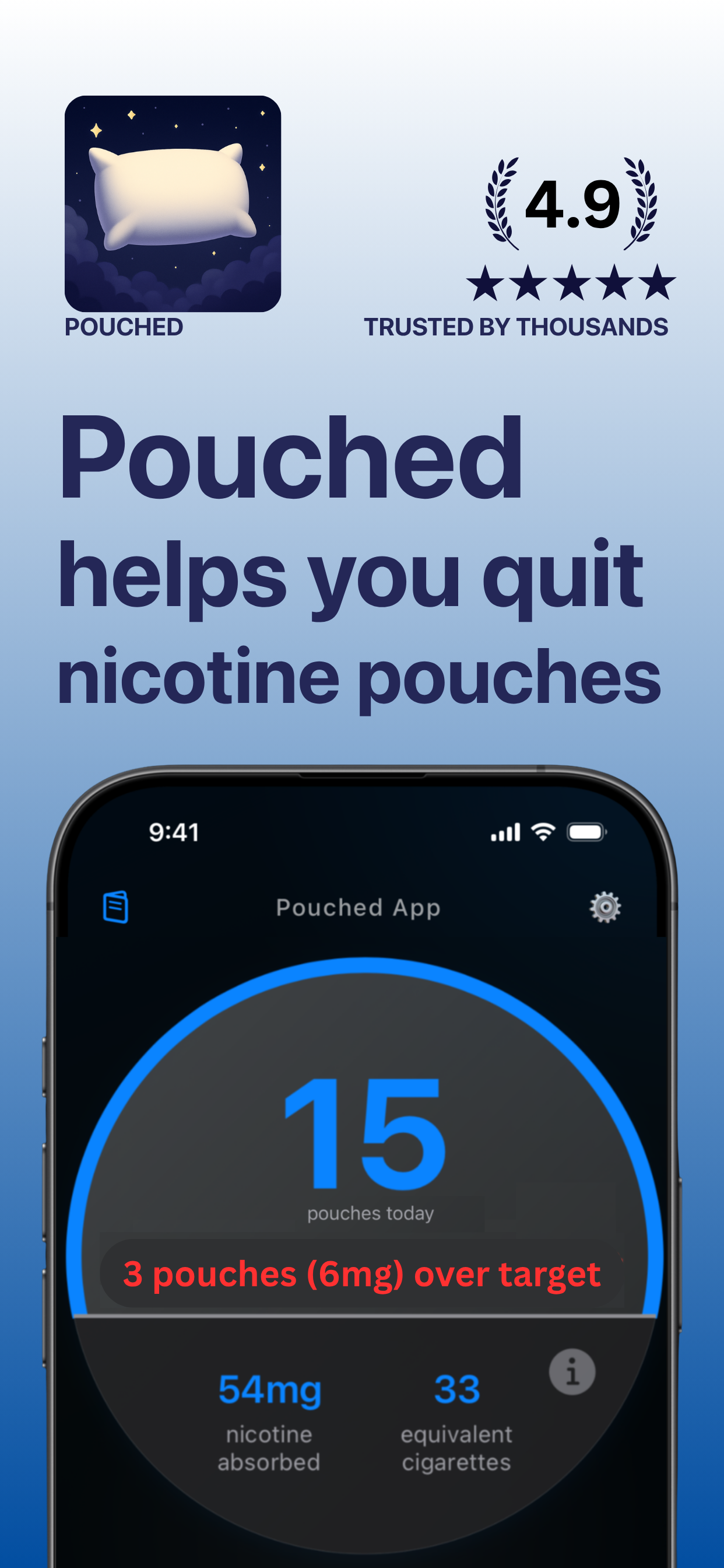
- Data from 5,000+ people who've used the Pouched app to quit
- My own messy, non-linear quit journey
This isn't about willpower. It's about strategy.
Track Your Progress Scientifically
Research shows you're 55% more likely to quit with a personalized plan
Get the Pouched App2. The Brain Science You Need to Know
You need to understand what nicotine is doing to your brain. Not to scare you—but because knowing the mechanism makes quitting easier.
Dopamine Hijacking
Nicotine doesn't create pleasure. It triggers your brain to release dopamine—the same chemical that fires when you eat, have sex, or accomplish a goal.
But here's the problem: your brain adapts. After repeated nicotine use:
- Your baseline dopamine drops
- Normal activities feel less rewarding
- You need nicotine just to feel "normal"
Why Pouches Feel Different Than Cigarettes
Nicotine pouches deliver nicotine more slowly than cigarettes but keep blood levels elevated for longer. This creates a "always slightly buzzed" state that your brain learns to expect as baseline.
That's why missing even one pouch can feel so uncomfortable—you're not craving a high, you're experiencing the absence of your new "normal."
The Good News
Your dopamine system can heal. Studies show:
- 72 hours: Nicotine fully leaves your system
- 2 weeks: Dopamine receptors start upregulating
- 3 months: Brain chemistry largely normalized
- 1 year: Addiction circuitry mostly rewired
But you have to give your brain time to adjust. That's where gradual tapering comes in.
3. What Happens When You Quit (Timeline)
Here's what to expect physiologically when you stop using nicotine pouches:
First 24 Hours
- Hours 1-3: Initial cravings begin
- Hours 4-8: Irritability peaks, difficulty concentrating
- Hours 12-24: Sleep disruption, restlessness
Days 2-3 (The Peak)
- Strongest cravings and mood swings
- Headaches common
- Increased appetite (your metabolism is adjusting)
- This is when most people relapse—expect this to be hard
Week 1
- Physical cravings start to decrease
- Mental fog begins clearing
- Sleep normalizes
- Gum sensitivity may improve (if you had it)
What About Gum Health?
Many heavy pouch users report gum recession, sensitivity, or white patches where they "park" the pouch. These often improve within 2-4 weeks of quitting, though severe recession may be permanent. If you see white lesions that don't heal, see a dentist.
Weeks 2-4
- Energy levels stabilize (often higher than before)
- Mood swings decrease
- Cravings become less frequent but can still be intense
Months 2-3
- Psychological cravings persist (triggered by stress, social situations)
- Your "pouch muscle memory" fades
- You stop automatically reaching for your can
Important: This timeline assumes gradual tapering or cold turkey from a moderate habit (8-15 pouches/day). Heavy users (20+ pouches/day) may experience more intense symptoms. Always consult a doctor if symptoms are severe.
4. The Real Cost of Nicotine Pouches
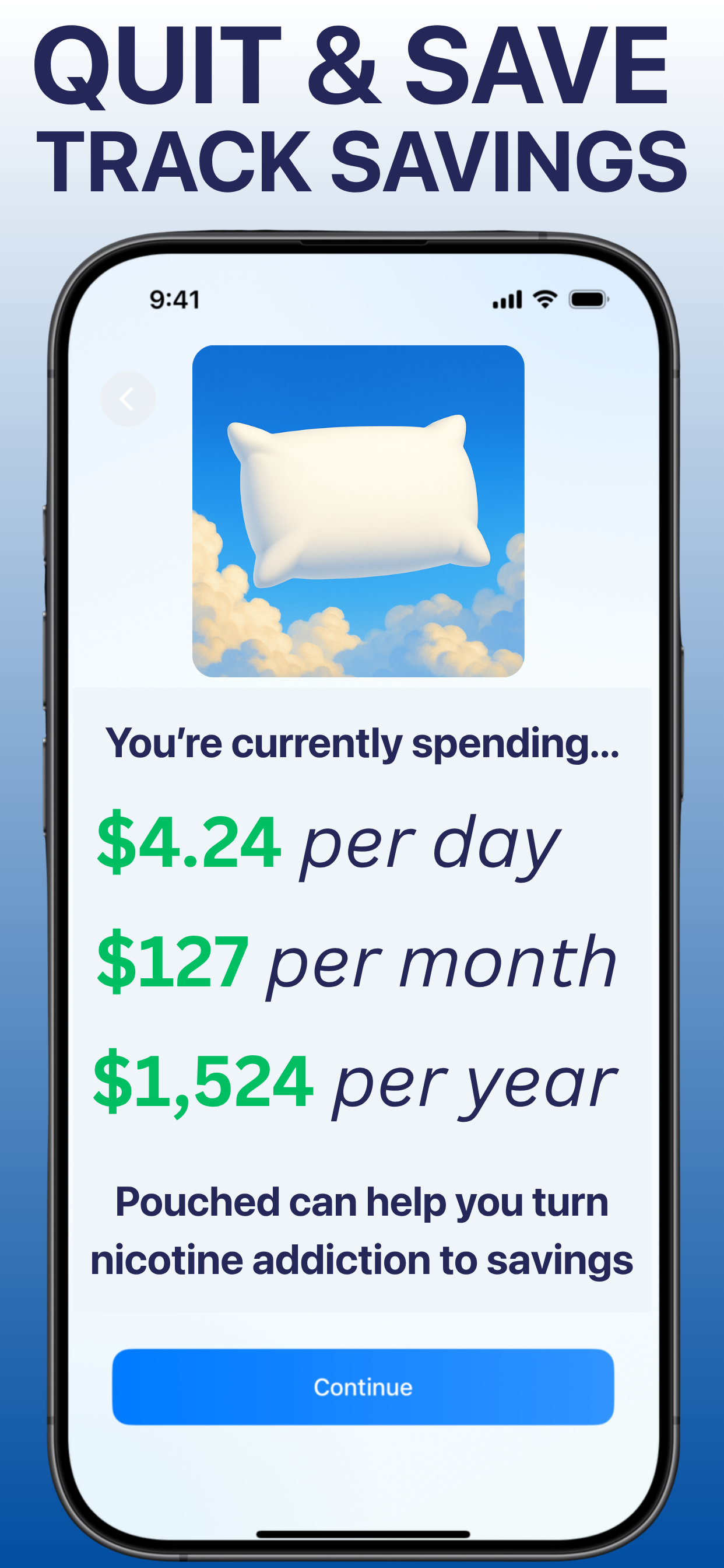
Let's talk money, because this might be the kick you need.
The Math
- Average can of Zyn/Velo/On!: $4-7 (varies by state)
- Pouches per can: 15-20
- If you're going through 1 can every 2 days (moderate use): $900-1,200/year
- If you're going through 1 can per day (heavy use): $1,800-2,500/year
That's not counting:
- Dental work from gum damage
- Productivity lost to nicotine fog
- The mental energy spent managing your supply
The Hidden Costs
Psychological cost: Every time you reach for a pouch, you're reinforcing the belief that you can't handle stress, boredom, or discomfort without it.
Social cost: Constantly excusing yourself to "put one in." Avoiding situations where you can't use pouches. The shame of hiding your habit.
Health cost: We don't have 30-year studies on nicotine pouches yet. You're in the experiment. Every pouch is a bet that they're as "harmless" as the marketing claims.
I'm not judging—I made that bet for years. But it's worth naming.
See How Much You Can Save
Track your usage and watch your savings grow. Turn pouch money into vacation funds.
Download Pouched App5. Week-by-Week Tapering Strategy (Overview)
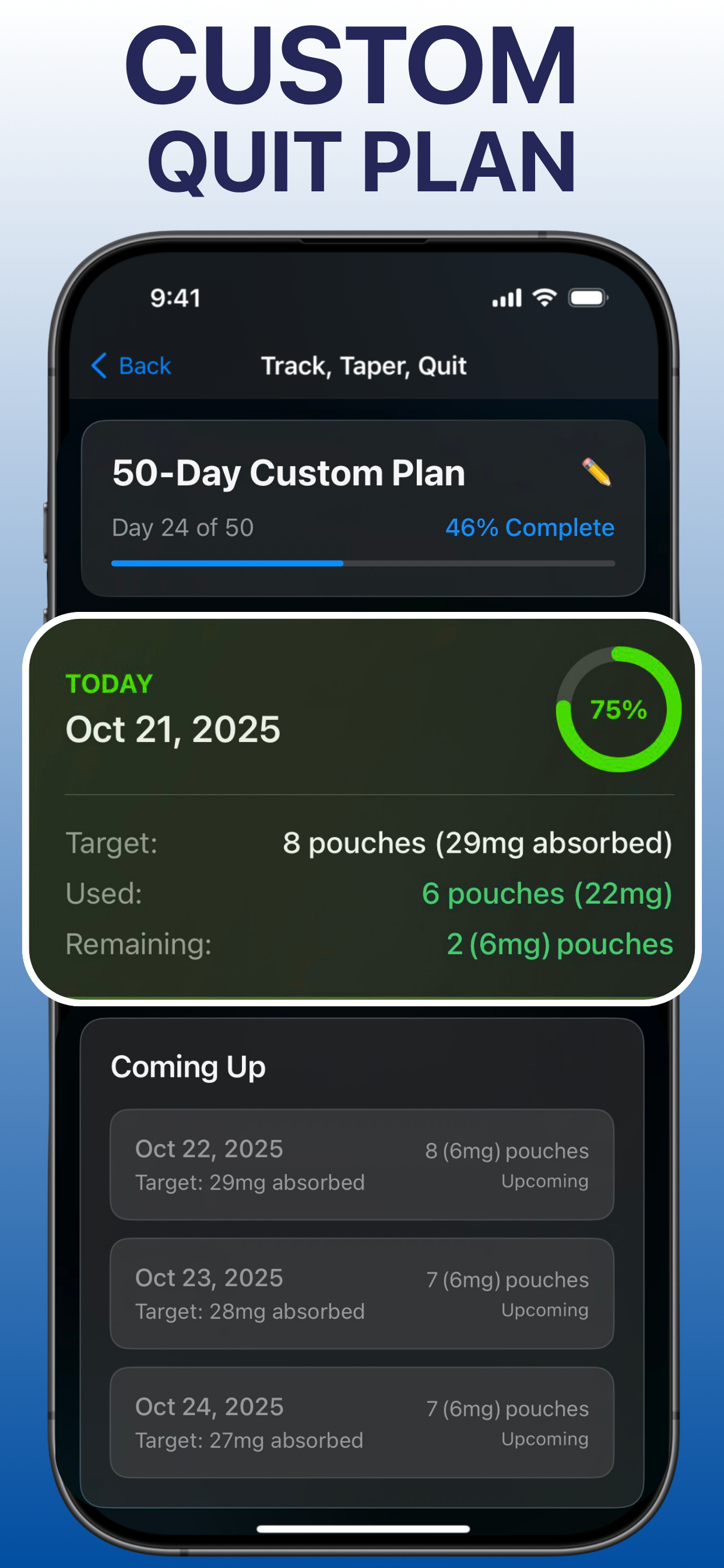
This is a 6-8 week gradual reduction plan. You can adjust the timeline based on your starting point and how you respond.
The core principle: Reduce slowly enough that your brain doesn't panic, but fast enough that you maintain momentum.
| Week | Goal | Target Reduction |
|---|---|---|
| 1 | Track without changing | 0% (baseline) |
| 2 | Cut easiest pouches | -10% to -20% |
| 3 | Remove 'autopilot' pouches | -20% to -30% |
| 4 | Replace boredom pouches | -30% to -40% |
| 5 | Tackle morning/stress triggers | -40% to -50% |
| 6 | Social/hardest pouches | -50% to -70% |
| 7 | Final taper | -70% to -90% |
| 8 | Zero day challenge | 100% (quit) |
Key insight: You don't quit all at once. You quit in layers, starting with the pouches that matter least.
6. Week 1: Gather Intelligence
Your only job this week: Track every single pouch.
Don't try to cut back yet. Just observe.
What to Track:
- Time: When did you use it?
- Trigger: What happened right before? (Stress? Boredom? Social situation?)
- Craving intensity: 1-10 scale
- Location: Where were you?
Why This Matters
Most people have no idea how many pouches they actually use or why they reach for them. You might think you use 10/day, but it's actually 17. You might think stress is your trigger, but it's actually boredom.
Data beats assumptions.
Example Tracking Log:
| Time | Trigger | Intensity | Notes |
|---|---|---|---|
| 7:15 AM | Morning routine | 8 | Always do this first thing |
| 9:30 AM | Boring Zoom meeting | 4 | Not a strong craving, just habit |
| 12:45 PM | After lunch | 7 | Feels automatic |
| 3:00 PM | Stress (work deadline) | 9 | Really needed this one |
| 6:30 PM | Driving home | 5 | Habit, not craving |
| 8:00 PM | Watching TV | 3 | Could skip this |
| 10:30 PM | Before bed | 6 | Part of wind-down |
Notice the pattern? Some pouches are high-intensity "need" pouches (morning, stress). Others are low-intensity "habit" pouches (TV, meetings).
You'll cut the low-intensity ones first.
7. Weeks 2-4: Strategic Cutbacks
Now that you have data, it's time to make your first cuts.
Week 2: The Easy Wins
Target: Eliminate 2-3 of your lowest-intensity pouches.
From the example above, you'd cut:
- 9:30 AM pouch (intensity: 4)
- 8:00 PM pouch (intensity: 3)
That's a -2 to -3 pouch reduction (roughly -15% to -20% if you were using 15/day).
Replacement Strategy
Don't just remove the pouch—replace the behavior:
- Bored in a meeting? Chew gum, doodle, drink water
- Watching TV? Sunflower seeds, mints, fidget with something
Week 3: Autopilot Pouches
These are pouches you use without thinking. You put one in because you always do, not because you're craving nicotine.
Common autopilot pouches:
- Right after meals
- While driving a familiar route
- During routine tasks (folding laundry, checking email)
Strategy: Delay the pouch by 10 minutes. Set a timer. Most "autopilot" cravings disappear if you wait.
User Story: Sarah, 28
"I realized I was putting in a pouch every time I got in my car—even for a 5-minute drive to the grocery store. I started leaving my can in my apartment. If I really needed one, I'd have to go back inside. Turns out I never did. Cut out 4-5 pouches a day just from that."
Week 4: The Substitution Game
By now you're down 30-40% from baseline. You're going to feel this.
Key principle: Your brain wants oral stimulation and a routine. Give it something else.
Best substitutes:
- Nicotine-free pouches: (e.g., Rogue Zero, Tea Pouches) – Same physical sensation, no nicotine
- Cinnamon toothpicks: Strong flavor, oral fixation
- Sunflower seeds: Keeps hands and mouth busy
- Ice chips: Numbing sensation mimics the tingle
8. Weeks 5-6: Breaking Your Hardest Habits
This is where it gets real. You've cut the easy pouches. Now you're facing the ones that feel essential:
- The morning pouch
- The stress pouch
- The "I'm out with friends drinking" pouch
The Morning Pouch
For many people, this is the hardest. Your brain has linked "waking up" with "nicotine."
Strategy: Delay and Replace
- Week 5: Delay your first pouch by 1 hour. Drink water, shower, eat breakfast first.
- Week 6: Push it to 2-3 hours. By the time you "allow" yourself to have one, the craving is often gone.
Bonus: Use caffeine strategically. A strong coffee can satisfy the "I need a boost" feeling.
The Stress Pouch
This is the one you reach for when work is overwhelming, you're anxious, or something goes wrong.
The trap: Nicotine doesn't actually reduce stress—it just relieves nicotine withdrawal. You feel "calm" because you're no longer in withdrawal.
The fix: Learn one real stress-reduction technique. I recommend the 4-7-8 breathing method:
- Breathe in through your nose for 4 seconds
- Hold for 7 seconds
- Exhale through your mouth for 8 seconds
- Repeat 3 times
Sounds cheesy. Works incredibly well. Activates your parasympathetic nervous system in 90 seconds.
User Story: Mike, 34
"I thought I needed pouches to deal with work stress. Turns out I needed pouches because I was in nicotine withdrawal all day. Once I quit, my baseline stress actually dropped. Wild."
9. Final Week: Going Zero
You're down to 2-3 pouches a day. Maybe just one. You're so close.
This is the moment most people get stuck.
Why? Because your brain says:
- "I've cut back so much, I can handle just 1-2 per day"
- "This is sustainable, why quit entirely?"
- "I don't want to deal with withdrawal"
Here's the truth: You can't maintain 1-2 pouches per day long-term. You'll creep back up. Every person who tries ends up back at their baseline within 6 months.
The 3-Day Zero Challenge
Day 1: Use only 1 pouch. Make it count. Savor it. Then go to bed.
Day 2: Zero pouches. Expect to feel irritable. Use all your replacement strategies. This will be hard.
Day 3: Zero pouches. Slightly easier than Day 2. The peak is behind you.
Day 4: Zero pouches. You're doing it.
After Day 3, you're through the worst of the physical withdrawal. After Day 7, your dopamine receptors start healing.
What to Do on Zero Day
- Tell someone: Accountability helps
- Clear your space: Throw out all cans, lighters, everything
- Plan your day: Stay busy, avoid boredom
- Hydrate like crazy: Helps flush nicotine faster
- Exercise: Releases dopamine naturally
Most important: If you slip, don't catastrophize. One pouch doesn't erase 7 weeks of progress. Log it, learn from it, move on.
Stay on Track with Pouched
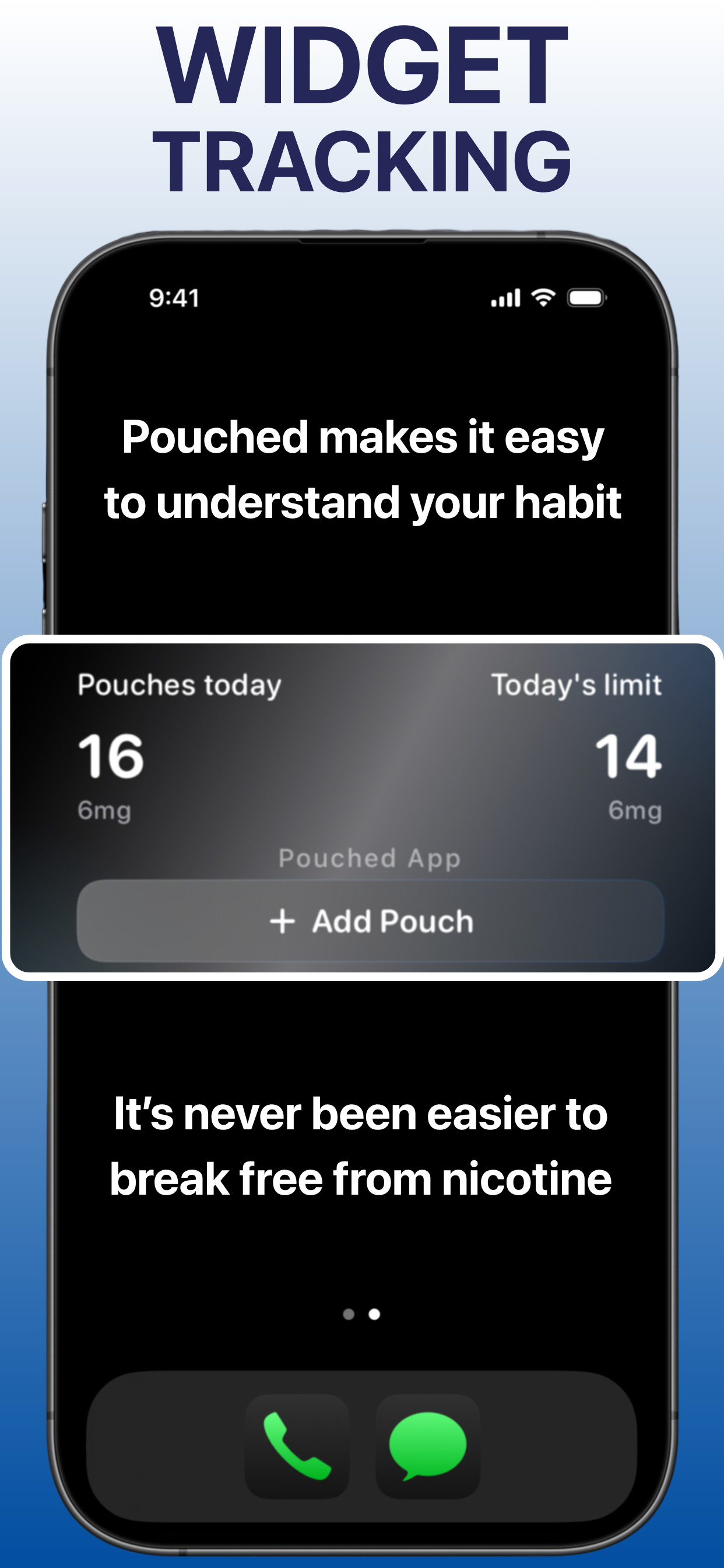
Log every pouch, follow a personalized tapering schedule, and see your progress day by day.
Download Pouched App10. Craving Toolkit (What to Do in the Moment)
Cravings are intense but short. Most last 3-5 minutes. Your job is to ride the wave.
Tool #1: The 90-Second Rule
Neurologically, an emotional impulse lasts 90 seconds. If you can distract yourself for 90 seconds, the peak of the craving will pass.
- Set a timer for 90 seconds
- Do literally anything else (walk, pushups, cold water on your face)
- Re-evaluate after the timer goes off
Tool #2: The 4-7-8 Breath
(Covered earlier—seriously, this works)
Tool #3: The Replacement List
Have these ready before you need them:
- Sugar-free gum (strong mint)
- Cinnamon toothpicks
- Ice water
- Sunflower seeds
- Nicotine-free pouches (if you need the oral sensation)
Tool #4: The Urge Surfing Technique
Don't fight the craving. Observe it like a wave:
- Notice where you feel it in your body
- Rate the intensity (1-10)
- Watch it peak
- Watch it fade
Cravings always fade. Always.
Tool #5: Play the Tape Forward
When you want a pouch, ask yourself:
- How will I feel 5 minutes after using it? (Guilty, back to square one)
- How will I feel 5 minutes after NOT using it? (Proud, one step closer)
Tool #6: The Identity Shift
Stop saying "I'm trying to quit." Start saying "I don't use nicotine pouches."
Identity change is more powerful than willpower.
11. Staying Clean After You Quit
You did it. You're nicotine-free. Now what?
Month 1: Vigilance Phase
- Psychological cravings will still hit (especially during stress)
- Avoid alcohol/parties where people are using pouches
- Keep using your replacement strategies
- Track your progress (even if it's just "Day 12: Zero pouches")
Months 2-3: Rewiring Phase
- Your brain is healing, but neural pathways are still sensitive
- "Just one pouch" will restart the cycle—don't test it
- Start noticing improvements: better sleep, more energy, clearer thinking
Month 6+: New Normal
- You rarely think about pouches
- Triggers don't hit as hard
- You've built new habits
Relapse Prevention
High-risk situations:
- Drinking alcohol (lowers inhibitions)
- Being around other pouch users
- Major life stress (breakup, job loss, etc.)
If you slip:
- Don't spiral ("I'm a failure, might as well buy a whole can")
- Log it honestly
- Identify the trigger
- Adjust your strategy
- Keep going
One pouch doesn't erase your progress. A full relapse does. Know the difference.
12. Frequently Asked Questions
How long does it take to quit nicotine pouches?
Physical withdrawal peaks at 72 hours and largely resolves within 2-4 weeks. Psychological cravings can last 2-3 months. Using a gradual tapering method (like this guide), most people quit fully within 6-8 weeks.
Should I quit cold turkey or taper?
Research shows gradual reduction has higher long-term success rates for most people. Cold turkey works for some (especially light users), but tapering reduces withdrawal intensity and relapse risk.
Can I use nicotine gum or patches to quit pouches?
Yes, but be cautious. NRT (nicotine replacement therapy) can help manage withdrawal, but you're still feeding the nicotine addiction. Many people find it easier to taper the pouches directly rather than switching to another nicotine source.
Will I gain weight?
Some people gain 2-5 pounds because nicotine suppresses appetite and increases metabolism. This is temporary and manageable through exercise and healthy snacking. The health benefits of quitting far outweigh minor weight changes.
What if I relapse?
Relapse is common and doesn't mean failure. Most successful quitters made 3-5 attempts before quitting for good. Analyze what triggered the relapse, adjust your strategy, and try again. Each attempt teaches you something.
Are nicotine pouches worse than cigarettes?
They're different risks. Pouches don't have the tar and carcinogens from combustion (cigarettes), but they deliver high nicotine doses and can damage gums. Long-term data is limited because they're relatively new. Neither is "safe."
How do I deal with cravings at work/school?
Use the 90-second rule, have replacement strategies ready (gum, toothpicks, water), and communicate your quit plan to supportive colleagues/friends so they can help you stay accountable.
Can I still drink alcohol while quitting?
Alcohol lowers inhibitions and is a major relapse trigger. Many people avoid drinking for the first 2-4 weeks of quitting. If you do drink, have a plan (bring gum, tell friends you're quitting, limit to 1-2 drinks).
What's the best app for tracking my quit?
Pouched is specifically designed for nicotine pouch users. It tracks usage, calculates savings, and provides quit plans. It's the only app built specifically for this.
Will my gums heal after quitting?
Mild gum irritation and sensitivity usually improve within 2-4 weeks. Gum recession can stabilize but may not fully reverse. See a dentist if you have persistent white patches, sores, or severe recession.
Ready to Start Your Quit Journey?
Download Pouched and join 5,000+ people breaking free from nicotine pouches
Get the Pouched App